Jungle, Drum & Bass and the Sound of 90s Britain - Where Shogun Comes From
I've been in love with jungle and drum & bass since the early 90s. There was nothing else like it - this raw, chaotic, incredibly fast music coming out of pirate radio stations and sweaty warehouse parties that felt genuinely dangerous and genuinely exciting at the same time. If you were there, you know. If you weren't, hopefully this gives you some idea of where it came from and why it still matters.
Because when I started planning Shogun - our upcoming drum & bass release here at Sub Sonic Audio - I didn't want to just make a pack of D&B sounds. I wanted to go back to where the music actually started and build from there. And that means starting with the breaks.
Where it all came from
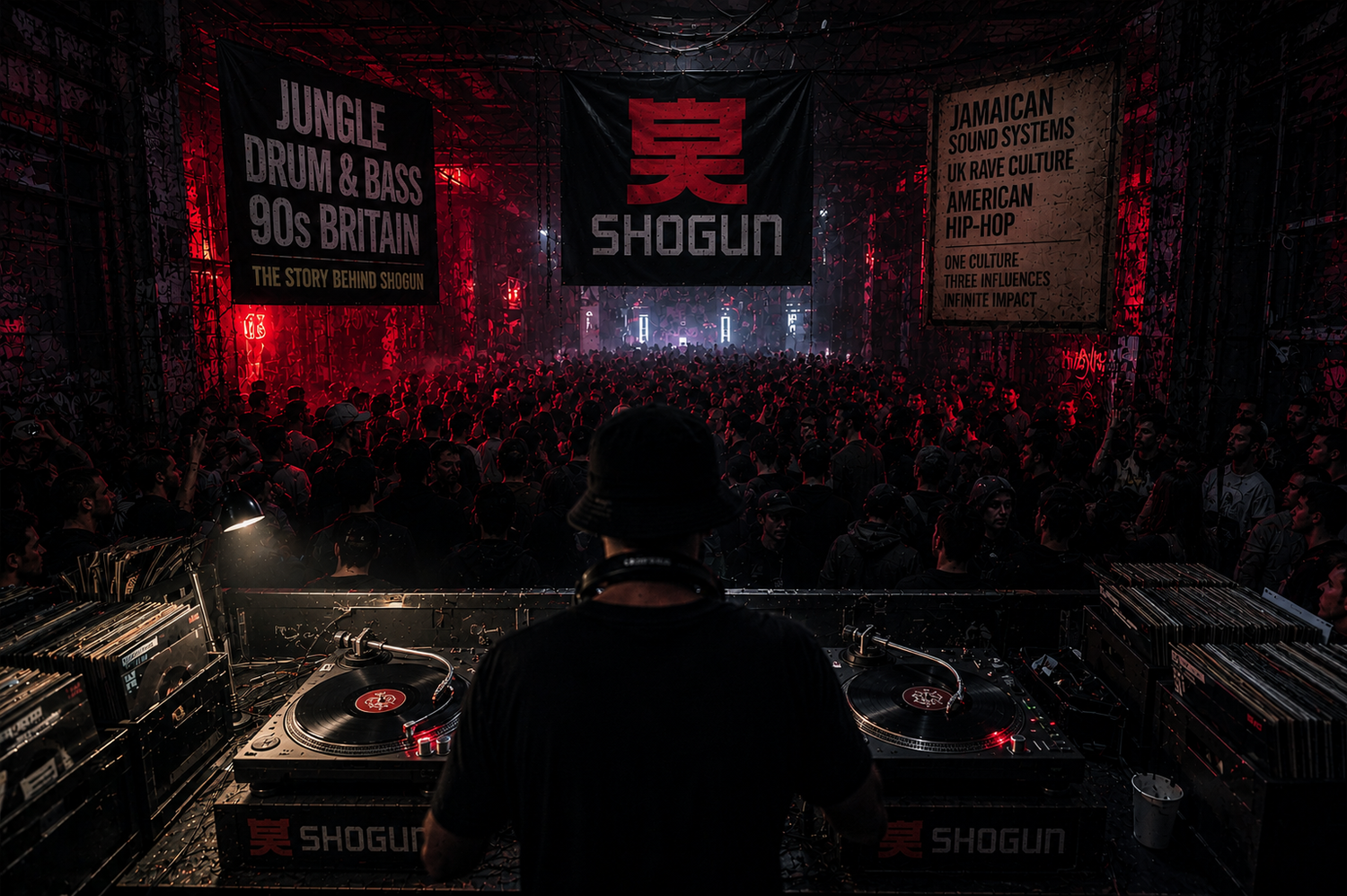
Jungle didn't arrive from nowhere. It was a collision - UK rave culture meeting Jamaican sound system culture meeting American hip-hop sampling techniques, all happening simultaneously in London, Bristol and Birmingham in the early 90s.
The dominant sound in UK raves at the time was breakbeat hardcore - fast, frenetic, built around sampled drum breaks and heavy basslines. But around 1992 and 1993, something started to shift. The tempo pushed higher, toward 160-170 BPM. The basslines got deeper and more reggae-influenced. The samples got chopped harder and more aggressively. Jamaican MC culture started appearing over the top. The result was jungle - and it sounded like nothing else on earth.
It was the sound of multicultural Britain in a way that very few genres have ever genuinely captured. Caribbean sound system culture, Black American hip-hop, European rave music - all feeding into each other, all filtered through a generation of young producers with samplers, pirate radio slots and something to say.
The breaks - where the rhythm comes from
You can't talk about jungle without talking about the breaks. The rhythmic foundation of the entire genre comes from a small handful of drum solos recorded decades earlier that producers started chopping up, pitching, speeding and rearranging into something completely new.
The Amen break - from Amen Brother by The Winstons, recorded in 1969 - is the most important of these and gets its own dedicated post on this blog. But two others deserve serious mention alongside it.
The Think break - from Think (About It) by Lyn Collins, 1972 - has a slightly different character to the Amen. Where the Amen is tight and snappy, the Think break has a looser, funkier feel with a slightly different snare crack that sits differently in a mix. Jungle producers used both, often layering them or switching between them to create rhythmic variety within a track.
The Apache break - from Apache by The Incredible Bongo Band, 1973 - brought something else entirely. That rolling, tribal tom pattern gave early jungle and hip-hop a completely different rhythmic texture. You can hear it across hundreds of tracks from the era - that unmistakable descending tom fill that became one of the most sampled moments in music history.
What made these breaks so useful wasn't just how they sounded - it was what happened when you manipulated them. Speed them up and they took on a completely different energy. Chop them and rearrange the hits and you could create rhythms that no live drummer could play. Put them through a sampler - an Akai S950, a Roland S760, an E-MU SP1200 - and sample those machines back into your DAW, and the sound changed again. The low-fi grit of vintage samplers at different bit depths and sample rates became part of the aesthetic. That roughness wasn't a bug. It was the point.
The tracks that defined the era
In 1993, a young Andy C and his production partner Ant Miles were working on the fourth release for their newly formed RAM Records - a label Andy had started just a year earlier. The A-side was a track called The Touch. Nobody remembers The Touch.
What they do remember is what ended up on the B-side. Going through leftover samples in the Akai sampler after finishing the A-side, the two stumbled onto something while experimenting with the timestretch function on a drum break. Ant Miles sculpted an arpeggio bell line from a sample CD Andy had got free with a magazine. An organic analogue string pad gave it a haunting, sinister atmosphere. And then came the vocal - sampled from a BBC QED documentary about near-death experiences: "I felt like I was in a long dark tunnel."
Valley of the Shadows by Origin Unknown - their production alias - became one of the first true anthems of the jungle scene and the track that cemented RAM Records as one of the most important labels in the genre. Andy C went on to become one of drum & bass's most respected and enduring figures, and RAM is still going strong over thirty years later. All from a B-side built around a free sample CD and a BBC documentary.
From jungle to drum & bass
By the mid 90s the scene was splitting. Jungle - with its reggae influences, MC culture and raw sample-heavy production - was moving in one direction. A cleaner, more precise, more melodic sound was emerging in parallel. The basslines got more sophisticated. The drums got tighter. The atmosphere got darker and more cinematic.
This became drum & bass - and labels like Moving Shadow, Metalheadz, V Recordings and 31 Records defined what it sounded like. Artists like Goldie, LTJ Bukem, Photek, Omni Trio, Roni Size and Adam F were making music that was genuinely unlike anything that had existed before. Intelligent, complex, emotionally heavy - but still rooted in those same chopped breaks and sub-bass pressure that jungle had started with.
Goldie's Timeless in 1995 is probably the moment the wider world took notice. An album that showed drum & bass could be serious, ambitious, long-form music - not just dancefloor fodder. Metalheadz - his label - became one of the most important in the genre's history.
But not everything that defined the era was complex and cinematic. Sometimes the most impactful things were the simplest. Zinc's bootleg remix of the Fugees' Ready or Not - released in 1996 on just 500 white labels with no official backing - is a perfect example. Raw, stripped back, built around a chopped break and a rolling bassline that hit like a freight train. It was so unofficial that when Zinc was asked about it years later at a Red Bull Music Academy lecture he paused, looked around the room and said "is this being recorded?" before everyone burst out laughing. The Fugees apparently loved it. That track - limited, underground, barely distributed - packed out rooms and had people stopping DJs mid-set to ask what it was. Proof that in this scene, impact had nothing to do with budget or polish.
Why it still matters
Jungle and D&B are still very much alive. The sounds have evolved through techstep, neurofunk, liquid funk, jump up and back around again - but the core of it is unchanged. Chopped breaks, sub-bass, forward momentum. The same ingredients that made those early pirate radio tracks so electrifying are still doing exactly the same job thirty years later.
For Shogun, I wanted to go back to the source. Not make a modern D&B pack that sounds like everything else - but build the sounds the way they were originally built. Real samplers. Vintage hardware. The breaks run through the Akai S950, the Roland S760, the E-MU SP1200 and the E-MU E4X at different sample rates. The same machines that defined the sound of the 90s, doing what they always did, just with the benefit of three decades of production knowledge behind them.
That's Shogun. More on that soon.