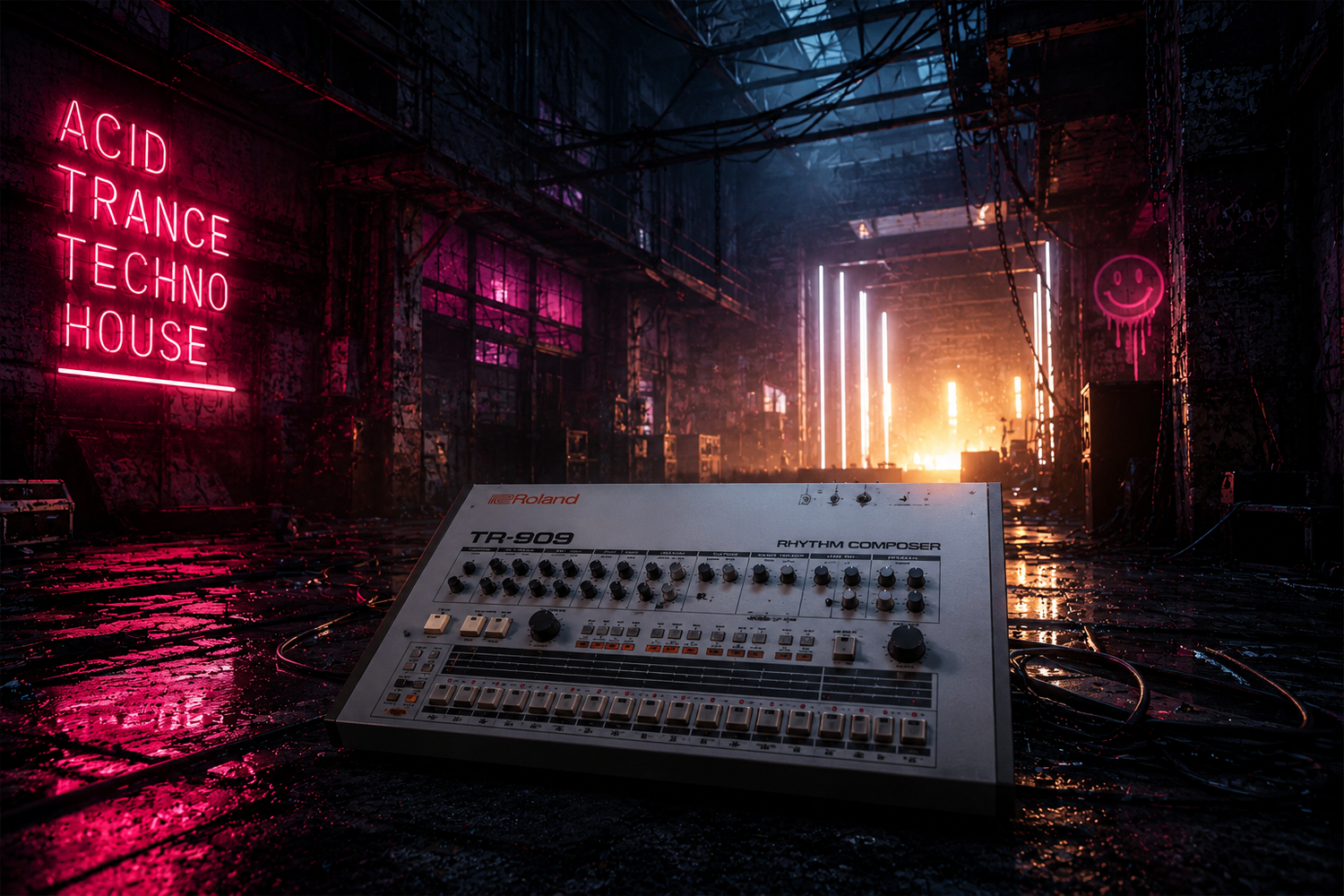
If the 808 was the drum machine nobody wanted that accidentally built four genres, the 909 is its younger sibling that did exactly the same thing and somehow gets slightly less credit for it. Which is criminal, frankly - because without the TR-909, house and techno as we know them simply don't exist.
Same story, different machine
Roland released the TR-909 in 1983, designed by the same engineer behind the 808 - Tadao Kikumoto. It was meant to be an upgrade. Where the 808 used pure analogue synthesis for everything, the 909 was a hybrid - analogue circuits for the kick, snare and toms, but digital samples for the hi-hats and cymbals. It was also the first Roland drum machine to feature MIDI, meaning it could sync with other gear in ways the 808 never could.
There's a brilliant story behind those hi-hats. Software engineer Atsushi Hoshiai - who also wrote the 909's code - couldn't get the cymbal sounds to work using analogue synthesis. With the deadline looming, he brought in his own personal cymbals from home: a mismatched pair of a 14" Paiste top and a 14" Zildjian bottom that he'd been using in his amateur jazz band for years. He recorded them with a Sony microphone, moving around the Roland offices at night looking for the right acoustic spot - eventually finding it next to a colleague's desk. Those samples were encoded at 6-bit resolution, giving them that crisp, slightly gritty metallic quality that's been on records ever since. Every 909 hi-hat you've ever heard in a club came from one bloke's mismatched jazz cymbals recorded in an office after hours.
On paper, it was more capable than its predecessor. In practice, nobody bought it.
Only 10,000 TR-909 units were ever made before Roland discontinued it in 1985. Like the 808 before it, the 909 was considered a commercial failure. And like the 808, what happened next is where the story gets interesting.
The price drops - again
When production ended, unsold 909s flooded the second-hand market for next to nothing. Some producers report picking them up in pawn shops and thrift stores for as little as $50. For the emerging communities of producers in Chicago and Detroit who were building something new with whatever they could afford, this was exactly the right machine at exactly the right moment.
Where the 808 and 909 differ
The two machines sound completely different and serve different purposes - and understanding why matters if you're building productions around either of them.
The 808 has that deep, boomy sine wave kick. It's designed to be felt as much as heard - long decay, huge sub energy, the kind of low end that moves a room. The 909 is punchier, more aggressive, faster in its transient attack. Its analogue kick drum cuts through a mix without heavy processing, its hybrid snare is sharp and characterful, and its digital hi-hats are metallic and instantly recognisable.
Put simply - the 808 hits you in the chest. The 909 hits you in the feet.
Chicago - the birth of house
Larry Heard's seminal 1986 track released on Trax Records used TR-909 drums throughout, and that distinctive ride cymbal became one of the defining sounds of deep house. Frankie Knuckles - arguably the godfather of house music - was given a 909 by Derrick May and by his own account never looked back. He described the low end of a house track as something that should be felt, not heard. The 909 delivered exactly that.
The four-on-the-floor kick pattern that defines house music to this day - that relentless, driving pulse that makes a room move - is a TR-909 kick. Every time you hear it in a club, in a festival field, on a streaming playlist, you're hearing the direct descendant of what those Chicago producers built with a machine Roland thought nobody wanted.
Detroit — techno finds its weapon
In Detroit, the 909 became something harder and more industrial. Juan Atkins, Derrick May and Kevin Saunderson - the Belleville Three, the originators of techno - built the foundations of the genre around the 909's mechanical precision and its ability to lock into a relentless groove. Jeff Mills took it even further, using the 909 as his primary instrument in live sets - programming and performing patterns in real time in ways that redefined what a DJ could do.
Richie Hawtin built entire minimal techno sets around the 909. Daft Punk used it. The Chemical Brothers used it. Even Madonna and Phil Collins used it - though perhaps with slightly different intentions than Jeff Mills.
The acid house connection
Pair the 909 with a Roland TB-303 bass synthesiser and you get something else entirely - the squelching, hypnotic pulse of acid house. The 303 and 909 together created a sound that spread from Chicago to the UK in the late 80s and changed club culture permanently. The UK rave scene, Madchester, Haçienda - all of it runs on that combination.
What makes the 909 sound the way it does
The hybrid design is the key. The analogue kick gives it warmth and punch. The digital hi-hats give it that sharp, metallic edge that cuts through a mix. The swing and shuffle function lets you push patterns slightly off the grid - creating a groovier, less mechanical feel that gives house music its distinctive human quality despite being entirely electronic.
And like the 808, the 909's sounds were never meant to be realistic. Nobody was trying to simulate an acoustic drum kit. They were creating something new - a rhythm language that didn't exist before these machines made it possible.
Trance - the 909 finds another home
Through the 90s and into the early 2000s, the 909 crossed over into a completely different world. Trance producers - particularly in Germany, the Netherlands and the US - latched onto the 909's punchy kick and crisp hi-hats as the rhythmic foundation for a sound that was bigger, more euphoric and more melodic than techno but shared the same mechanical precision underneath.
BT - was producing some of the most beautifully crafted trance of the era. Flaming June, Godspeed, Remember - productions that took the 909's rhythmic backbone and built something genuinely emotional around it. Sweeping pads, intricate arrangements, that unmistakable sense of forward momentum that only a locked-in 909 groove can give you. He proved the machine wasn't just a tool for dark rooms and industrial warehouses - in the right hands it could make something that genuinely moved people.
Artists like Paul van Dyk, ATB, Ferry Corsten, Tilt, AVB and Tiësto were doing the same thing across Europe - that four-on-the-floor kick driving under enormous synthesiser pads and euphoric breakdowns. That's the 909 again, doing what it does best in a completely different context.
It's exactly why the 909 is at the heart of our upcoming Lumina release here at Sub Sonic Audio. Lumina is our trance project - and to do it properly, you go back to the machine that defined the sound in the first place.
The 909 today
The 909 dominated all forms of electronic music from 1989 onwards - from the charts to the heaviest DJ sets imaginable. Its sounds are everywhere. Every sample pack, every DAW, every plugin library has a 909 kit in it somewhere. Roland reissued it as the compact TR-09. Behringer cloned it as the RD-9. Software versions model its circuits digitally.
But like the 808, there's something about the original hardware - the way the analogue circuits breathe, the way the kick responds to the decay knob, the feel of programming patterns on the physical step sequencer - that no software version has quite captured.
Only 10,000 were ever made. Roland thought nobody wanted it. House, techno, acid and trance producers proved them spectacularly wrong.