The Roland TR-808 - How One Drum Machine Built Four Genres
I'll be honest with you - when I decided DIRT 80X was going to be built around the Roland TR-808, it wasn't a difficult decision. If you're going to start somewhere, you start with the machine that basically wrote the rulebook for electronic music production. But to understand why the 808 matters so much, you have to go back to where it came from.
A machine nobody wanted
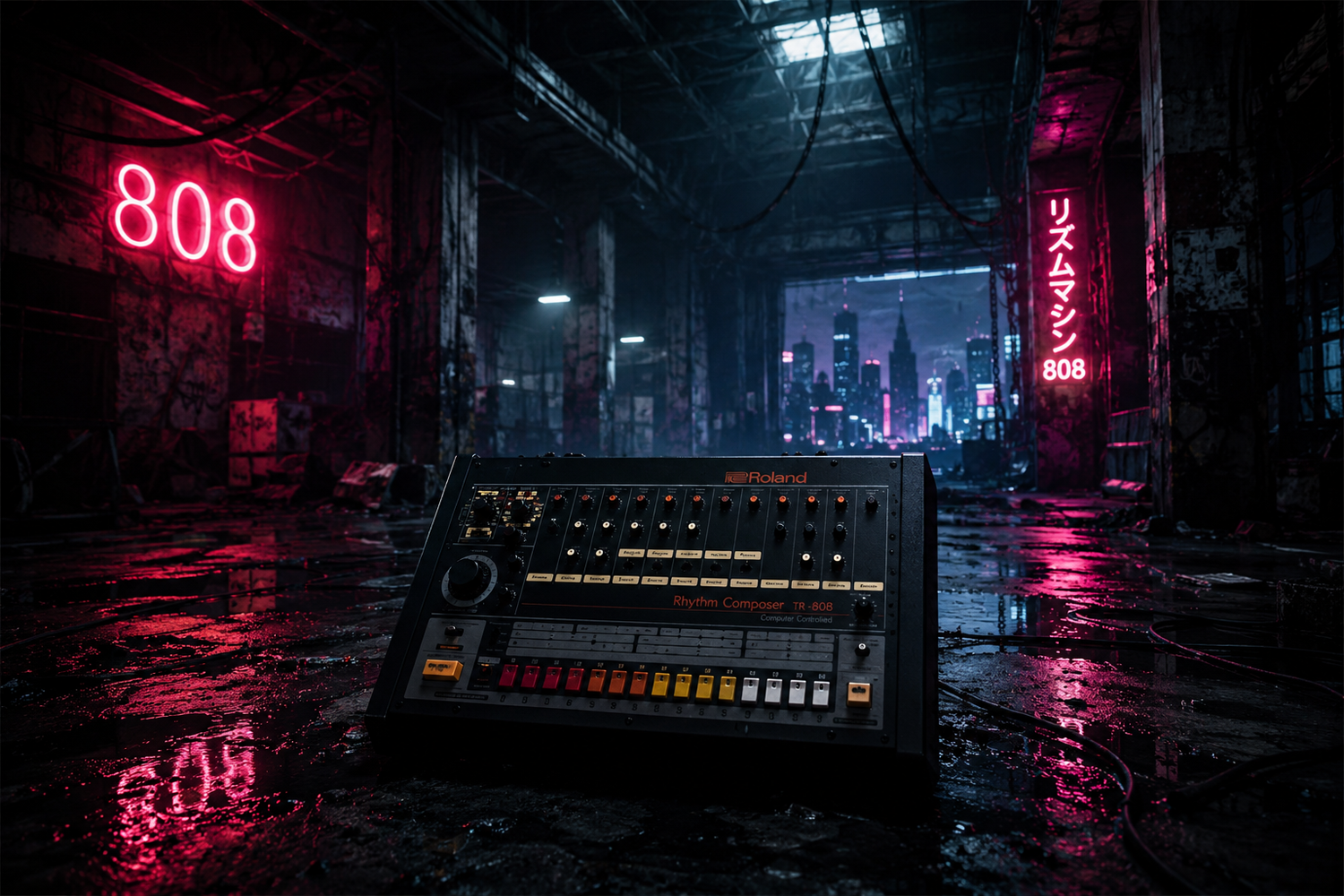
Roland released the TR-808 in 1980. At the time it was competing with the Linn LM-1 - a drum machine that used actual digital samples of real drums and cost around $5,000. Roland's chief engineer Tadao Kikumoto took a different approach entirely. Instead of samples, the 808 used analogue synthesis to generate its sounds - and to keep costs down, it used transistors that were actually slightly out of spec. The result sounded nothing like a real drum kit. The kick was a deep, booming sine wave. The snare was a sharp metallic crack. The hi-hats were thin and brittle. Critics hated it. The 808 was considered a commercial failure.
Roland discontinued it in 1983. Fewer than 12,000 units were ever made.
Then something unexpected happened.
The price drops and everything changes
When Roland pulled the plug, unsold 808s flooded the second-hand market for as little as $100. For broke producers and bedroom musicians who couldn't afford proper studio gear, this was a gift. And what they did with it changed music permanently.
Hip-Hop
In New York, Afrika Bambaataa picked up an 808 and used it on Planet Rock in 1982 - fusing it with Kraftwerk samples and creating electro-funk. The hip-hop world took notice immediately. By the time Dr. Dre's The Chronic landed in 1992, the 808 kick and its iconic trunk-rattling bass were practically the sound of the genre. Kanye West's 808s & Heartbreak in 2008 brought it back to the mainstream all over again. Today's trap music - with those long, sub-heavy 808 bass slides - is a direct descendant of what those early producers discovered in that cheap, discontinued drum machine.
House Music
In Chicago, DJ Pierre and his crew were using the 808 alongside a Roland TB-303 to create something nobody had heard before - a squelching, hypnotic groove that became acid house. The 808's handclap - which sounds absolutely nothing like actual hands clapping, by the way - became a signature of Chicago house and has never really gone away. That clap is everywhere.
Techno
In Detroit, Juan Atkins reportedly bought his first 808 while still in high school. He understood immediately that it wasn't trying to sound like a real drum kit - it was something else entirely. Something new. The 808 gave techno producers the ability to build patterns from scratch, place sounds exactly where they wanted them and create rhythms that felt mechanical, hypnotic and deeply human at the same time. The tension between those two things is what techno still runs on today.
Breakbeat and Beyond
As sampling technology evolved through the late 80s and early 90s, producers started running 808 sounds through samplers - chopping them up, pitching them down, layering them with breaks. The 808 kick became a bass instrument. The 808 handclap became a snare replacement. Its sounds took on new lives entirely, feeding directly into the UK rave scene and the breakbeat productions that would eventually become jungle and drum & bass.
Why I built DIRT 80X around it
When I started thinking about what the first Sub Sonic Audio release should be, the 808 made complete sense. Not because it's trendy - it's been trendy for 40 years, that ship has sailed - but because it genuinely crosses every genre I care about. Hip-hop, house, techno, breakbeat. The 808 is the common thread running through all of them.
What I wanted to do differently was process those sounds the way records used to be made. Run them through the Akai S950, the Roland S760, the EMU SP1200 and the E-MU E4X at different sample rates. Push them through real analogue outboard. Let them pick up the character that only comes from passing audio through real hardware. That's DIRT 80X. Not a recreation of the 808 - a reinterpretation of it, built for the way producers actually work today.
The machine Roland thought nobody wanted ended up being the most important drum machine ever made. Funny how that works.